Showing posts with label Neil Gaiman. Show all posts

Friday, July 1, 2016

Chu's Day at the Beach by Neil Gaiman, illustrated by Adam Rex

“When Chu sneezed, big things happened.” Chu is a little panda bear whose sneezes are larger than life, and cause big problems! In Chu’s Day at the Beach, Chu and his parents go to the beach, where everything starts off perfectly. The ice cream seller (an orange octopus with a bowtie and sunglasses) gives Chu an extra scoop of vanilla. But as soon as Chu takes off his sunglasses, his nose tickles, and sneezing is inevitable.  Chu’s sneeze is so big that he parts the sea in two! When a baby whale is separated from its parent on the other side of the sea, the people at the beach try to get Chu to sneeze with feathers and bubbly soda, but nothing works.

“All of the grown-ups were very sad. ‘Chu will not sneeze,’ they said. ‘Now the sea is broken and we cannot fix it.”


Neil Gaiman might be known for his books for older children and adults, but his stories of Chu the little panda who sneezes is absolutely delightful. Adam Rex’s illustrations capture Chu and the characters at the beach in such detail that each time reading uncovers a new character or illustration detail. In bright blues, yellows, and reds, this is the perfect read for the summer, and since it is now available in a board book format, a great handheld size for ages 0 to 3. Will Chu ever put the sea back together? Grab this board book and find out!

"It was a hot day, and Chu and his family went to the beach."

Friday, October 31, 2014

The Case for Retellings

Neil Gaiman
Photo: Kimberly Butler
Why retell a fairy tale? If you have something new to say. And Neil Gaiman retells Hansel & Gretel in a truly haunting, original way. Lorenzo Mattotti's illustrations picture not a house brightly accented with rainbow-colored candy, but rather a dark wood where shadow prevails.

Here, Gaiman focuses on the ravages of war, and turning out the children as a means of survival for the parents. It's as grim as a fairy tale gets. Unless you read Adam Gidwitz's A Tale Dark and Grimm, in which the parents try to decapitate Hansel and Gretel (they get their heads back). Yet Gaiman also conveys the father's conflict--he doesn't want to "lose" his children in the woods, and delights in their return.

Lorenzo Mattotti
Gaiman also characterizes the candy-covered home's owner as an "old woman," never a witch. Having painted these as destitute times, the author gives readers some empathy for the old woman and what drives her to desperate measures. Another of my favorite riffs on Hansel & Gretel is Donna Jo Napoli's novel The Magic Circle, which provides a history for "the Ugly One," as the witch in her retelling is called, and adds a layer of complexity as well.

Mattotti's artwork is stunning in its relentless swirls of dark shadows, which make manifest the darkness of the woods, yes, but also the dark side of the parents, which dominates their psyches enough to turn out their own children. The father here shares much in common with the father in Gaiman's recent adult book The Ocean at the End of the Lane, as if the man, overtaken by his obsession with a woman, is unable to stay true to his role as protector of his children. (Though Gaiman disagrees with my interpretation of the father's motives in Ocean in a very thought-provoking way.)

Thursday, October 23, 2014

Chillers & Thrillers


 As Halloween draws near, we have some favorite chillers and thrillers, from board books to YA novels to audiobooks. The Hallo-Wiener by Dav Pilkey, debuting in a board book edition, stars a Dachshund named Oscar, teased by his canine peers for his shape, size and bun costume--until he proves to be the perfect foil to a menacing "monster."

Two beginning readers emphasize the treats of friendship: Dog and Bear: Tricks and Treats by Laura Vaccaro Seeger and Katy Duck's Happy Halloween by Alyssa Satin Capucilli, illustrated by Henry Cole. Don't forget Adam Gidwitz's original spin on the Brothers Grimm, starting with A Tale Dark and Grimm, and closing with The Grimm Conclusion. Another book to keep readers up nights (in the best way) is Guys Read: Thriller, edited by Jon Scieszka. Candace Fleming uses a real cemetery as a backdrop for her collection of spinetingling tales On the Day I Died; the audiobook would make a sensational soundtrack for a haunted houseparty.

The YA short stories in Monstrous Affections, edited by Kelly Link and Gavin J. Grant, include as many psychological thrillers as situational chillers. Two teenage friends drink down a petrified bat with unnerving results in Glory O'Brien's History of the Future by A.S. King. Hitting close to home in the wake of the Ebola virus, Love Is the Drug by Alaya Dawn Johnson combines spies, intrigue and a deadly pandemic. 

Readers can now enjoy Neil Gaiman's Newbery Award–winning The Graveyard Book three ways: the original novel, the audiobook (read by the author) and the new two-volume graphic novel set (adapted by P. Craig Russell). Check out Kevin Nowlan's rendering of the bloody knife that opens Volume 1, and Scott Hampton's climactic scene in the Frobisher Mausoleum in Volume 2.

This round-up first appeared in Shelf Awareness for Readers.

Friday, October 11, 2013

Time Matters

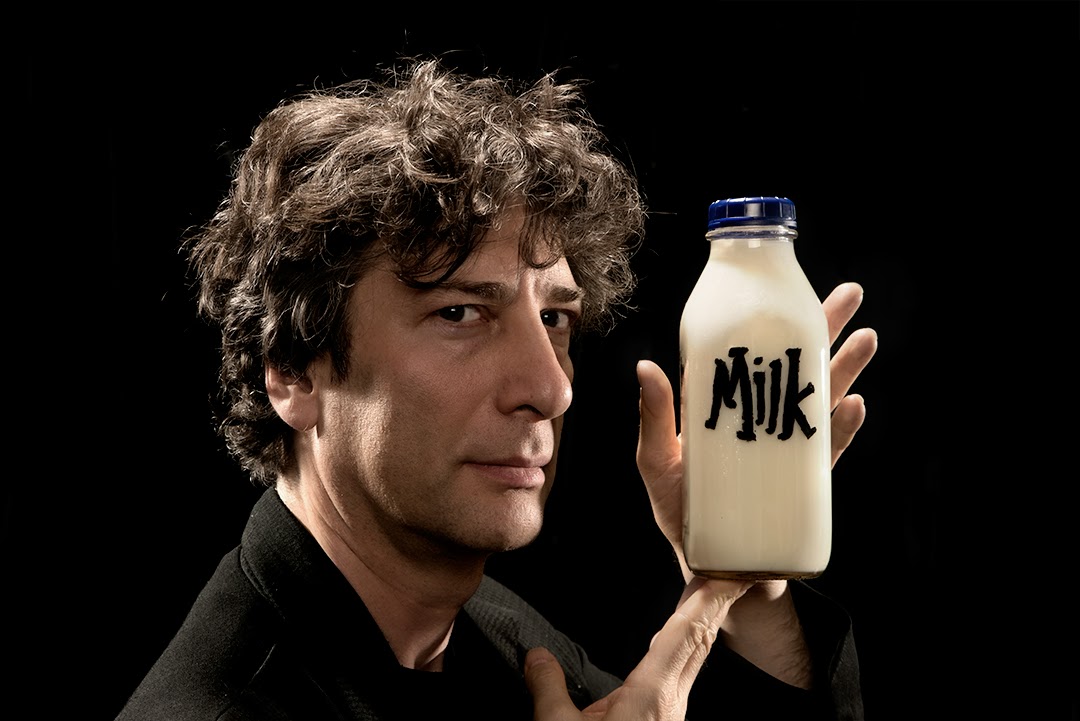
The father in Fortunately, the Milk by Neil Gaiman, illustrated by Skottie Young, disrupts the space-time continuum when he escapes through an emergency exit, against the wishes of his alien captors. All the man wants to do is take some milk back to his children for their breakfast.
Neil Gaiman
Photo: Brady Hall

His children believe that their father is taking a very long time to buy milk for their Toastios. The people and creatures their father meets on his journey live in an era different from his. Professor Steg, for instance, believes they are in the future, but the father knows the Stegasaurus is from the past. The aliens are outside of time, and who knows what era the pirates belong to.

Gaiman plays with the elasticity of time. Time passes quickly from the father's perspective, as he moves swiftly through time periods and challenging situations, milk safely in hand. To the children, time plods along at a snail's pace. As we wait for a loved one, time moves slowly; when we are swept up in events, time moves quickly.  In an ever more programmed world--programmed by events as well as technology--time moves at a breakneck pace. 

As an early adopter, Gaiman was one of the first to join Twitter. He tweets throughout the day and often crafts a blog entry from them at night. He uses Twitter to reflect in the moment, and his blog to reflect on the day. So it was especially interesting to hear Gaiman say, when I got a chance to interview him recently, that he plans to take a break from social media. Why? Gaiman says, "I would like to be bored more. I don't think I get bored enough these days, and I think boredom is a brilliant, brilliant way of coming up with ideas."

Time to be "bored" feeds the imagination. Time to do nothing, matters.

Friday, April 26, 2013

An Unorthodox Collaboration

Most writers and artists who work on picture books together do not meet until after their book is published. Rarely does the author get to pick the artist. But when Daniel Handler (aka Lemony Snicket) saw a piece of art by Jon Klassen in which the dark spoke, he was inspired to write a picture book called The Dark.

When I got to speak with them about their unorthodox collaboration for Kirkus Reviews, Handler said, "For a moment, it looked like The Dark was going to be Jon Klassen's first book, and then it looked like it was going to be his lifetime achievement award." 

Interestingly, Handler similarly approached author-artist Maira Kalman about working together on a picture book called 13 Words, which led eventually to the Printz honor–winning novel Why We Broke Up. Both Klassen and Kalman have an uncanny ability to tell stories through visual details. 


Daniel Handler, Neil Gaiman and Jon Klassen (l.-r.)
Photo credit: Cheryl Simon
We got to host the first "performance" of The Dark at the School for Children at the Bank Street College of Education. Their dynamic presentation was a comedy of opposites: Daniel Handler, standing in for Lemony Snicket, as the gregarious jokester, played against Jon Klassen as the nearly silent poker-face partner. Neil Gaiman also made an appearance as the voice for the audiobook (the only book he's recorded that he did not also write, he told us when he visited Bank Street).

Handler and Klassen's real-time banter in many ways played out the way they described collaborating on the book. Their push and pull allows children to be active participants; as readers, they sense young Laszlo's growing confidence as he confronts the dark (after his night light burns out) and uses his flashlight like a beacon to navigate to the darkest, remotest corner of his house.

Handler and Klassen's respect for each other is profound, but they also have a great deal of fun together, as you will discover in this recap of their performance (by Bank Street archivist Lindsey Wyckoff, with many photos), and in the "review" of their stage presentation by Betsy Bird (aka Fuse #8 and the New York Public Library's Youth Materials Collections Specialist.).

Thursday, October 29, 2009

Gestation

The Graveyard Book was 20 years in the making, according to Neil Gaiman in his 2009 Newbery acceptance speech. He first got the idea for the book when he watched his son, Michael, ride his tricycle in the cemetery of his old Sussex neighborhood. Michael is now taller than his father. He is 25; the same age Gaiman was when he started The Graveyard Book.

What a terrific example to share with young people about how to slow down and not rush things. From the time we are children in school, we are often driven by deadlines. We have due dates for written reports and oral presentations, we attend practices to prepare for football or basketball games, track or swim meets, recitals and plays. Once we enter the working world, there, too, we have due dates for reports, projects, and presentations to bosses, colleagues, and clients.

It’s easy to get caught up in the goal and lose sight of the process. It wasn’t always just about the trophy, was it? At first, wasn’t it the pure pleasure of running under the trees, or swimming out to the sandbar, or giving voice to a song? We start as amateurs, in its original sense of cultivating something for the love of it. Maybe we return to it because it gives us joy, and the more we run or swim or sing, the better we get. We run sprints and swim laps and practice scales, and we learn more about how far we can go. And if we're lucky, and if we stay with it, one day it all comes together.

In those intervening 20 years, Neil Gaiman did not stop writing. He wrote his Sandman series, American Gods and Coraline, to name a few. But he did eventually return to The Graveyard Book. Gaiman said that when he wrote the last two lines of his Newbery Medal-winning novel, he realized, “I had set out to write a book about a childhood . . . I was now writing about being a parent. The fundamental most comical tragedy of parenthood: If you do your job properly . . . they won't need you anymore. If you did it properly, they go away.” He continued, “I knew I'd written a book that was better than the one I had set out to write.”